How to Read an International Shipping Quote: Hidden Items and Fair Comparison | 0551247117

How to read an international shipping quote from Saudi Arabia line by line: 12 items you should see in writing, door to door vs port to port, FOB and CIF, a worked comparison of two quotes, and warning signs.
Two quotes for the same shipment can be a thousand riyals apart — and the higher one may actually be cheaper. The reason is that an international shipping price is not one number but a set of items: some are written in the quote, some are mentioned on loading day, and some you only discover when your shipment reaches the destination port. In this guide we take a quote apart line by line: what each item means, the question to ask about it, and how to compare three quotes fairly before you sign.
Article map17ShowHide
- Why do two quotes for the same shipment differ?
- Anatomy of a quote: 12 items you should see in writing
- Delivery terms: what “door to door” and “port to port” mean
- Pricing unit: kilogram, cubic meter or container?
- A practical comparison: how the cheapest quote becomes the dearest
- Five steps to compare three quotes fairly
- Signs of an unreliable quote
- Charges that may appear after arrival
- Quotes for individuals vs companies
- How we prepare a quote
- Frequently asked questions
- Does the quote include customs duties at the destination?
- Can the price change after we agree?
- How long is a shipping quote valid?
- Why do you ask for photos or a survey before pricing?
- Do I pay the full amount upfront?
- What is the difference between clearance fees and customs duties?
Why do two quotes for the same shipment differ?
Before judging any number, know that every company builds its quote on assumptions that may not match the next company’s. A gap between quotes doesn’t necessarily mean one is inflated; usually each one prices something different. These are the four main reasons:
Anatomy of a quote: 12 items you should see in writing
This table is the checklist we use ourselves when preparing any quote, and you can use it to review a quote from any company. If an item isn’t written, ask about it before you compare.
| Item | The question to ask | Why it matters |
|---|---|---|
| Main transport | From exactly which point to which point? | The difference between door to door and port to port can equal a third of the cost. |
| Packing | Is it included, and with which materials? | Weak packing means damage on the road that nobody covers. |
| Dismantling and assembly | Is dismantling included? Assembly at the destination? | Assembly abroad is often a separate service that wasn’t mentioned. |
| Loading and lifting fees | Do they vary by floor and lift availability? | The item most often added by surprise on the day. |
| Export clearance | Who prepares and submits the export documents? | One missing document delays loading by days. |
| Import clearance | Are the broker’s fees included? | Not the same as customs duties — the two are often confused. |
| Customs duties and taxes | Were they estimated, and who pays? | In some destinations and for some items they exceed the freight cost. |
| Insurance | Included or optional? On what value? | Without insurance the full loss falls on the shipment owner. |
| Storage and demurrage | How many free days at the port or warehouse? | A late consignee means daily fees that add up fast. |
| Final delivery | To the door? Which floor? Who unloads the truck? | “We’ll deliver it” is not a sufficient answer. |
| Quote validity | Until when is the price valid? | Prices move with seasons and vessel schedules. |
| Currency and variable charges | Is the price in riyals? Does it include fuel surcharges? | Fuel surcharges and exchange rates raise the bill after agreement. |

Delivery terms: what “door to door” and “port to port” mean
In commercial shipping, quotes use short codes that define where the shipper’s responsibility ends and yours begins — the international delivery terms. Understanding them stops you comparing an all-inclusive quote with one that stops at the port:
| Term | Simply put | What remains on you |
|---|---|---|
| Door to door | From pickup to the consignee’s door | Usually only duties and taxes, unless stated otherwise. |
| Port to port | From the departure port to the arrival port | Transport to the port, clearance and inland delivery abroad. |
| EXW | Goods ready at the seller’s warehouse only | Almost everything: transport, export, freight and clearance. |
| FOB | The seller delivers the goods on board the vessel | Sea freight, insurance and import clearance. |
| CIF | The seller pays freight and insurance to the arrival port | Clearance, port charges and inland transport at the destination. |
| DDP | Everything paid to the door, including duties | Almost nothing — which is why its price looks higher. |
Pricing unit: kilogram, cubic meter or container?
Every quote relies on a charging unit, and knowing it tells you whether the quote makes sense:
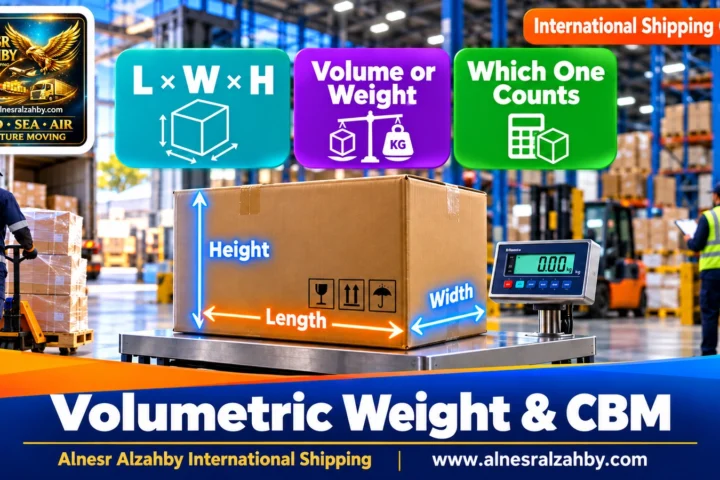
- Air freight and parcels: charged on “chargeable weight”, the greater of actual and volumetric weight. A large light box can be charged as if it were heavy.
- Shared sea freight (LCL): usually charged per cubic meter, or per tonne if the cargo is very heavy for its size.
- Full container (FCL): a fixed price for a 20ft or 40ft container, however full it is.
- Road freight: by volume, load or full truck depending on the shipment size.
Before requesting any quote, work out the unit yourself with the shipping cost basis calculator or the CBM calculator, and read the full explanation in volumetric weight and CBM. If a quote says three cubic meters and your calculation says five, ask about the difference before signing.
A practical comparison: how the cheapest quote becomes the dearest
An example of two realistic-looking quotes for a small apartment move from Riyadh to Dubai. Quote A looked 800 riyals cheaper:
| Item | Quote A — SAR 4,000 | Quote B — SAR 4,800 |
|---|---|---|
| Main transport | ✅ Included | ✅ Included |
| Packing | ❌ Charged later (about SAR 600) | ✅ Included |
| Dismantling and assembly | ❌ On the customer | ✅ Included |
| Lifting fees | ❌ By floor (about SAR 300) | ✅ Included up to the 4th floor |
| Clearance | ❌ Separate (about SAR 500) | ✅ Included |
| Delivery | To the warehouse only (about SAR 500 to deliver) | To the consignee’s door |
| Real cost | About SAR 5,900 | SAR 4,800 |
Five steps to compare three quotes fairly
Signs of an unreliable quote

Charges that may appear after arrival
Even a good quote may not fix every destination charge in advance, but a professional company names them and estimates them. Ask about these specifically:
- Port or airport handling: paid at the arrival port for unloading the container or parcels.
- Demurrage: daily fees if the shipment stays at the port after the free days.
- Inspection fees: if customs opens the shipment — more likely with vague lists.
- Duties and taxes: vary by country and goods; used personal effects may be exempt under conditions.
- Inland transport: from the port to the consignee’s city if not included.
If your shipment is valuable, read our cargo insurance guide before signing, the guide to costly international shipping mistakes, and the list of questions to ask a shipping company before you pay.
Quotes for individuals vs companies
How we prepare a quote
We show our method not to persuade you, but so you know what to expect from any serious company:
Frequently asked questions
Does the quote include customs duties at the destination?
It should state this explicitly. Every quote we send says whether duties are included, estimated or on the consignee. Used personal effects may be exempt in some destinations under conditions, while commercial goods are usually dutiable.
Can the price change after we agree?
A detailed quote doesn’t change once approved as long as the shipment is as described. If the volume grows, the delivery point changes or a service is added, the price changes only by that amount.
How long is a shipping quote valid?
It is stated in the quote itself, often two weeks, because prices follow seasons, vessel schedules and fuel charges.
Why do you ask for photos or a survey before pricing?
Because estimating without seeing the shipment often misjudges volume — sometimes by a full cubic meter — which changes the price on loading day. Photos bring the quote closer to the final cost.
Do I pay the full amount upfront?
The usual arrangement is a deposit on booking and the balance on delivery, or as agreed in writing. Avoid anyone asking for the full amount before collection without a clear reason.
What is the difference between clearance fees and customs duties?
Clearance fees pay the broker who submits documents and completes procedures; customs duties are a tax the state levies on the goods. A good quote separates the two.
Turn what you just read into a quote
Send your shipment details and receive a written quote with the price, transit time and the best shipping mode.
More from this section
Related reads on the same type of service.