
Shipping Valuables and Antiques: Packing, Documentation and Insurance Step by Step | 0551247117

How to ship valuables, artworks and antiques internationally from Saudi Arabia: the four packing layers, when a wooden crate is worth it, packing by item type, documentation, insurance and customs considerations.
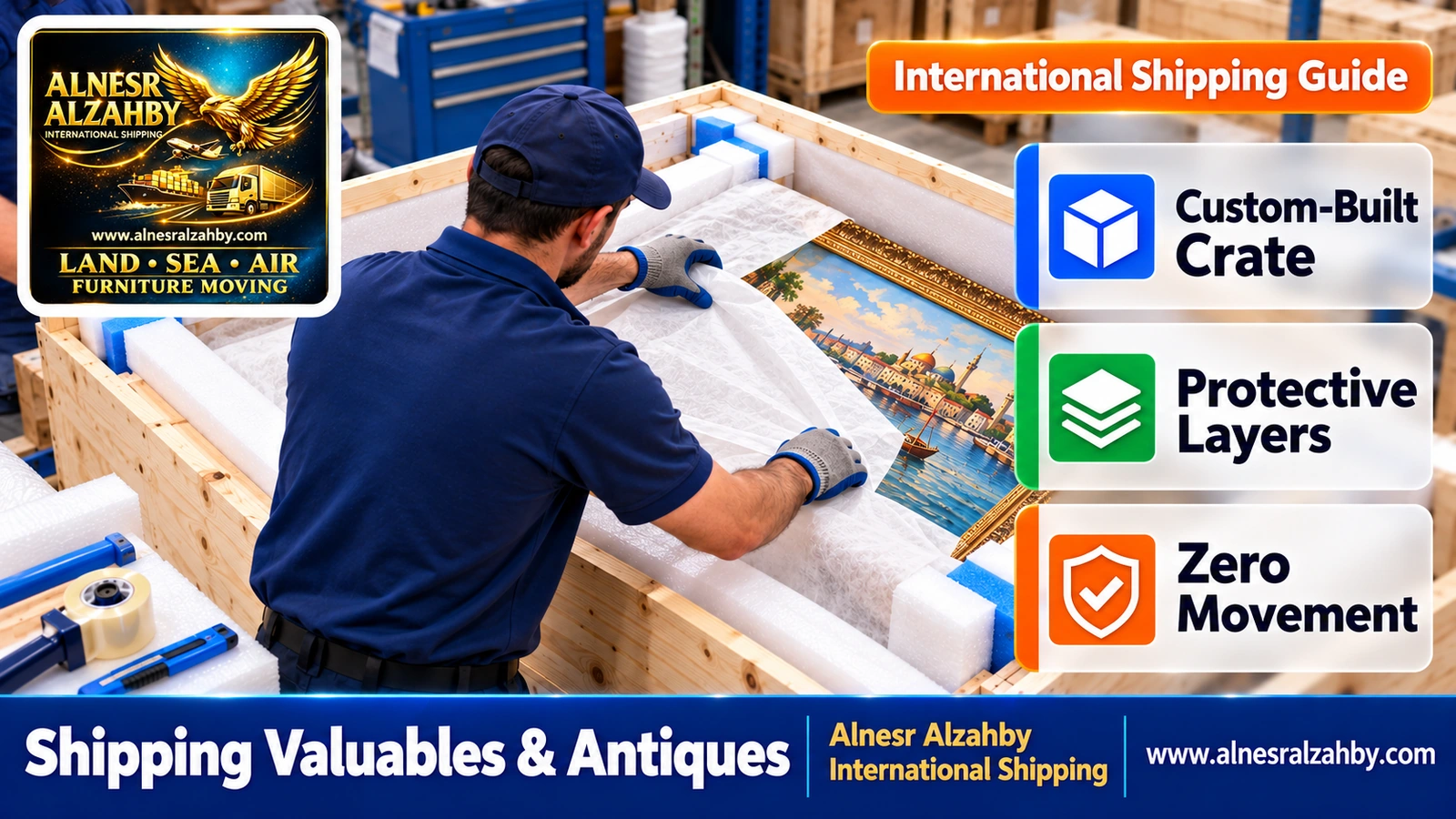
Irreplaceable pieces need different handling from the rest of the shipment: custom packing, closer documentation, insurance at a realistic value, and sometimes a made-to-measure wooden crate. An inherited painting, an antique bought on a journey, a valuable musical instrument or a large mirror — one mistake in packing or documenting it can mean losing it for good. In this guide we explain how to ship valuables and antiques across borders: what counts as a valuable piece, the four packing layers, when a wooden crate is worth it, how to document each piece, and the customs considerations that apply.
Article map14ShowHide
- What counts as a valuable piece?
- Layered packing: four layers
- Packing each type separately
- Documentation: your first line of defence
- Insuring valuables
- Special customs considerations
- Common mistakes with valuable pieces
- Frequently asked questions
- Do you ship artworks?
- Can jewellery be shipped?
- How much does a wooden crate cost?
- Does insurance cover antiques?
- What if my piece is an antiquity?
- Are mirrors carried flat or upright?
What counts as a valuable piece?
Layered packing: four layers
Packing each type separately
| Piece | Packing method | Important note |
|---|---|---|
| Oil painting | Acid-free paper on the face without pressure, then corner guards and a frame, then a crate | Never let bubble wrap touch the paint directly. |
| Painting behind glass | Tape in a star pattern on the glass to hold fragments if it breaks, then packing | Broken glass scratches the painting if not held. |
| Large mirror | Corner guards, foam layers and two boards of cardboard or wood, carried upright | Never loaded flat under any weight. |
| Ceramics and small antiques | Individual wrapping, then a box inside a box with padding on every side | No part should touch the outer box wall. |
| Musical instrument | In its hard case if available, strings loosened and gaps padded | Avoid exposure to extreme heat. |
| Marble table | Marble separated from the base, a wooden board behind it, carried upright | Marble breaks under its own weight if carried flat without support. |
Documentation: your first line of defence
- Photograph from six angles: front, back, both sides, top and bottom, with a close-up of any existing mark or scratch.
- Record dimensions and weight: useful for pricing and for proving the piece’s identity in any dispute.
- Keep any proof of value: a purchase invoice, a valuation or a certificate of authenticity all support the declaration and a claim.
- Photograph the piece after packing too: proof that the packing was suitable before shipping.
- Keep the records for weeks after delivery: some internal damage doesn’t show immediately.
Insuring valuables
Insurance replaces money, not the piece, but it is essential for high-value items. Watch three points:
Full details are in our international cargo insurance guide.
Special customs considerations
Some antique and art pieces are subject to special export or import rules and may need permits, certificates of authenticity or proof of ownership. Don’t assume your piece is ordinary just because it has been in your home for years:
- Old antiquities: may need an export permit from the competent authority before leaving the Kingdom.
- High-value artworks: may face duties or valuation procedures at the destination.
- Materials under international restrictions: such as ivory, some rare woods and leathers, which are banned or restricted in many countries.

Common mistakes with valuable pieces
- Putting them in ordinary furniture boxes with no marking to set them apart.
- Declaring a lower value to save on the insurance premium.
- Wrapping them directly in plastic, which traps moisture and sticks to sensitive surfaces.
- Carrying mirrors and large paintings flat under other furniture.
- Not inspecting them on delivery before signing. Avoid the other mistakes in costly international shipping mistakes.
Frequently asked questions
Do you ship artworks?
Yes, with layered packing and made-to-measure wooden crates for large or valuable pieces, carried upright.
Can jewellery be shipped?
Not in regular shipments. It needs different secured arrangements; it is best to carry it with you.
How much does a wooden crate cost?
It depends on size and complexity, and is listed as a separate item in the quote before you approve.
Does insurance cover antiques?
It covers the declared value under the policy, and proof of value may be requested for rare pieces.
What if my piece is an antiquity?
Tell us in advance. Some pieces are subject to special export or import rules that must be checked before loading.
Are mirrors carried flat or upright?
Always upright, with corner guards and two protective layers on both faces.
Turn what you just read into a quote
Send your shipment details and receive a written quote with the price, transit time and the best shipping mode.
More from this section
Related reads on the same type of service.